Skip to content
Questions

Visibility Towards Other Road Users

Visibilidade relativamente aos outros utentes da via

276 questions

Learned: 0 / 276

Question 1

Can riding over road markings be dangerous for riders of two-wheeled vehicles?
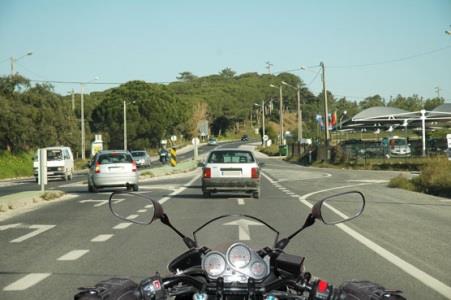
ANo, because the material of the markings increases grip.
BYes, but only in urban riding.
CYes, always.

Why — Explanation

Road markings can be slippery, especially when wet, so riding over them is always a hazard for two-wheeled vehicles.
Question 2

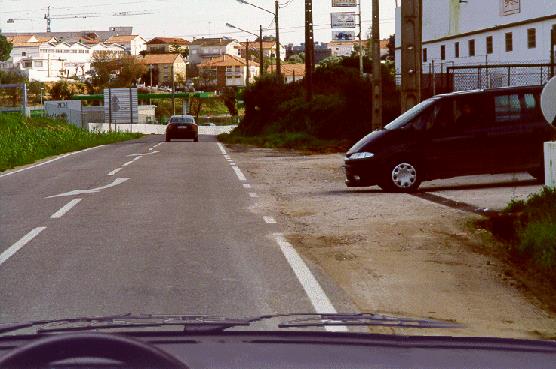
The purpose of motorcycles always riding with dipped headlights (luzes de cruzamento) on is:

ATo avoid blind spots.
BTo make their presence more noticeable to other road users.
CTo always have better visibility of the road.

Why — Explanation

Riding with dipped beam at all times makes the motorcycle easier for other road users to see.

Question 3

How far should I ride from the kerb (berma)?

AAt a distance never less than 5 metres.
BAt a distance never more than 5 metres.
CAs close as possible.

Why — Explanation

The general position rule requires riding as close as possible to the right-hand edge of the carriageway, keeping only a safe distance from the kerb.

Question 4

When meeting a large vehicle, I should pay particular attention to:

AThe grip of the heavy vehicle's tyres on the road surface.
BThe height and length of the heavy vehicle.
CThe instability and fragility of the vehicle I am riding.

Why — Explanation

A two-wheeled vehicle is unstable and fragile, and the air displaced by a large vehicle can easily upset it.

Question 5

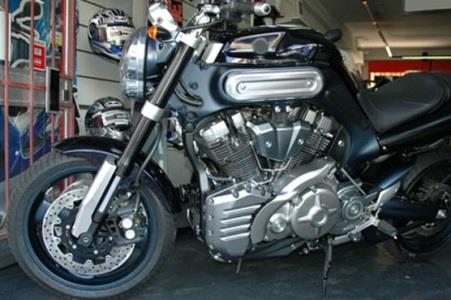
When choosing a motorcycle, the rider should take into account:

AThe type of transmission of the vehicle.
BThe types of spark plugs and filters of the vehicle.
CWhether, once seated, their feet reach the ground.

Why — Explanation

Being able to put both feet on the ground when stopped is essential for balance and control of the motorcycle.

Question 6

While riding, can sudden acceleration that does not cause skidding compromise the stability of a motorcycle?

AYes, because acceleration reduces the grip of both tyres.
BYes, because acceleration reduces the grip of the front tyre.
CYes, because acceleration reduces the grip of the rear tyre.

Why — Explanation

Hard acceleration shifts weight onto the rear wheel and unloads the front tyre, reducing its grip and the stability of the steering.

Question 7

The lights that a motorcycle must have at the rear are:

AA brake light and a position light.
BMain beam and position lights.
CPosition lights and a fog light.

Why — Explanation

At the rear a motorcycle must carry a red position light and a red brake light (stop light).

Question 8

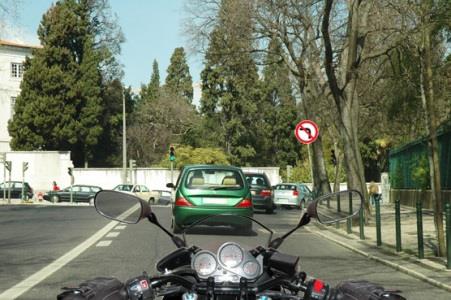
I am riding very close to the traffic lane on my left. Am I riding correctly?

ANo, because I should be riding in the left-hand lane.
BNo, because I should ride as far to the right as possible.
CYes, because I am riding in the right-hand lane.

Why — Explanation

Within your lane you should keep as far to the right as possible, not near the lane on your left.

Question 9

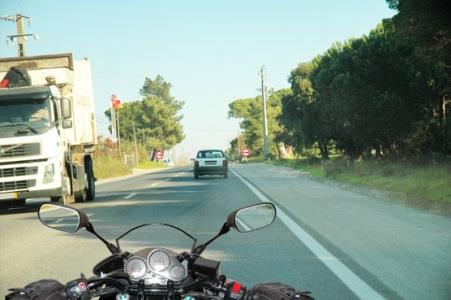
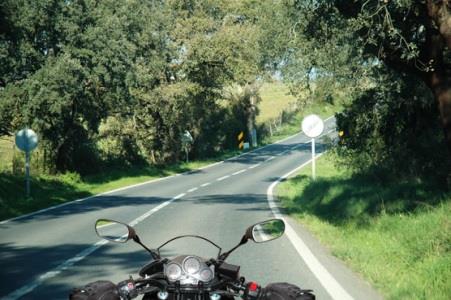
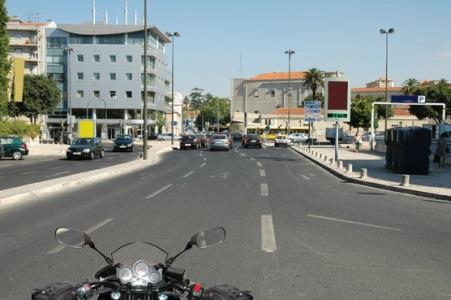
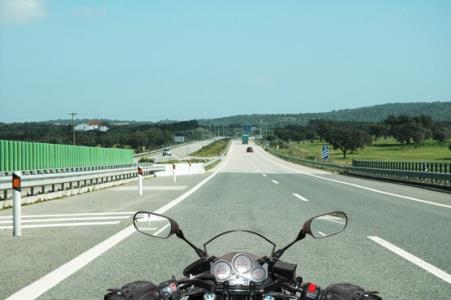
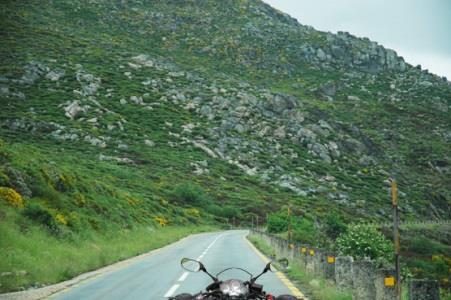
How should I proceed in this situation?

ARide close to the centre line of the carriageway to take the bend safely.
BRide along the edge of the carriageway.
CRide at a specially moderate speed.

Why — Explanation

Where the road layout limits how far you can see, you must moderate your speed so you can stop within the visible space.

Question 10

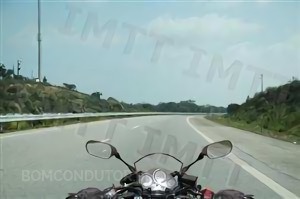
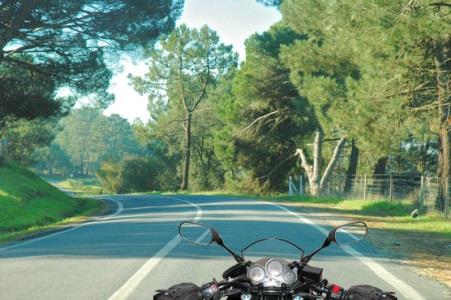
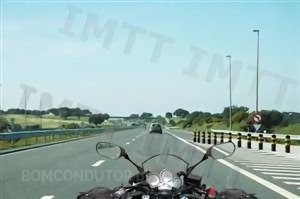
How should I proceed to take the bend safely?

AAdapt my speed to the characteristics of the bend.
BRide to the right of the verge.
CRide close to the centre line of the carriageway.

Why — Explanation

Speed must be adapted to the radius and visibility of the bend before entering it.

Question 11

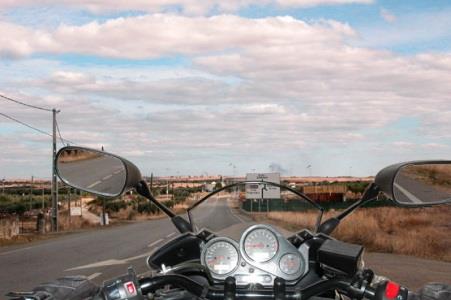
How should I proceed when approaching a crest (lomba)?

ASwitch on the dipped headlights.
BRide close to the centre line of the carriageway.
CRide at a specially moderate speed.

Why — Explanation

A crest hides the road ahead, so you must slow down enough to stop within the distance you can see.

Question 12

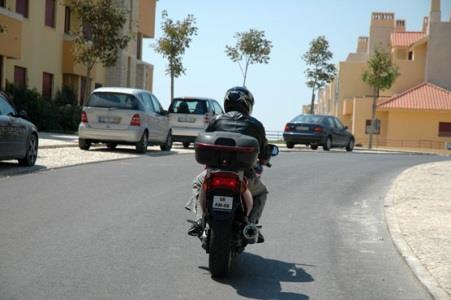
In well-lit built-up areas, the motorcyclist should ride:

AWith the dipped headlights on.
BWith the main beam headlights on.
CWith the position lights on.

Why — Explanation

Motorcyclists must use dipped headlights at all times, even in well-lit built-up areas.

Question 13

In a built-up area, during the day, motorcycles must ride:

AWith the dipped headlights on.
BWith the position lights on.
CWith lower tyre pressure.

Why — Explanation

The dipped headlights must be on whenever the motorcycle is moving, day or night, inside or outside built-up areas.

Question 14

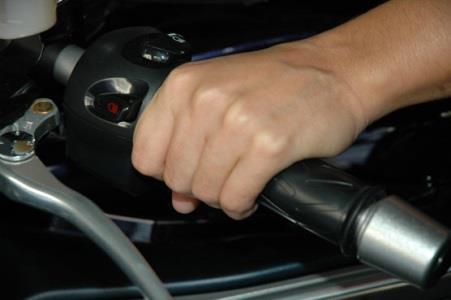
I should ride a motorcycle with both hands on the handlebars, except when:

AI adjust the mirrors.
BI ride on a non-urban road during the day.
CIf necessary, I signal a change of direction.

Why — Explanation

One hand may leave the handlebars only briefly, to signal a manoeuvre when needed.

Question 15

I should only switch on the dipped headlights at night.

ARight.
BWrong.

Why — Explanation

Motorcyclists must ride with dipped headlights on at all times, not only at night.

Question 16

Should I use the left-hand lane on a motorway (auto-estrada)?

ANo, never.
BYes, when riding at speeds above 90 km/h.
CYes, when I am overtaking.

Why — Explanation

On a motorway the rule is to use the rightmost lane; the other lanes may only be used for overtaking.

Question 17

Under what circumstances should I ride with my dipped headlights on?

AOnly when riding on motorways.
BOnly when there is heavy traffic.
CIn any and all circumstances.

Why — Explanation

The dipped headlights must be on whenever the motorcycle is on the road, without exception.

Question 18

Under what circumstances should I take care to check the rear-view mirrors?

AOnly when vehicles are travelling close behind me.
BOnly when performing a manoeuvre that involves a sideways movement of the vehicle.
CRegularly, but quickly.

Why — Explanation

The mirrors should be checked often and with quick glances, not only before lateral manoeuvres.

Question 19

When riding a motorcycle, is constantly riding close to the centre line of the carriageway a correct and safe position?

ANo.
BYes, because different trajectory options are guaranteed.
CYes, because the best viewing angles and several trajectory options are guaranteed.

Why — Explanation

The rule is to ride as far to the right as possible and to choose the position according to traffic, visibility and the layout of the road.

Question 20

When riding a motorcycle, a significant increase in speed means:

AIncreased reaction time.
BIncreased time available to think and react.
CDecreased time for gathering relevant information.

Why — Explanation

The faster you ride, the less time you have to gather information, decide and react.

20 / 276