Question 1
Should the clutch control lever normally have some free play?
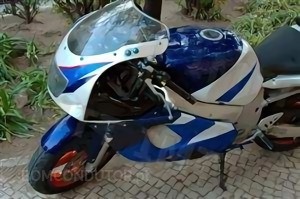
ANo.
BYes, approximately 2 to 3 mm.
Why — Explanation
A small free play at the clutch lever, about 2 to 3 mm, guarantees that the clutch engages fully and does not slip.
Constituintes do veículo
151 questions
Question 1
Why — Explanation
A small free play at the clutch lever, about 2 to 3 mm, guarantees that the clutch engages fully and does not slip.
Question 2
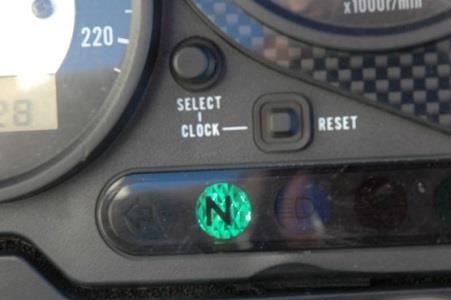
Why — Explanation
The green N light is the neutral indicator: it shows the gearbox is in neutral, with no gear engaged.
Question 3
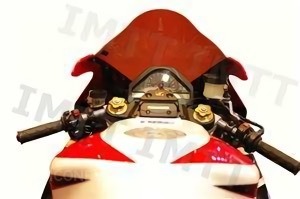
Why — Explanation
The position light makes the motorcycle visible to other road users from at least 150 metres away.
Question 4
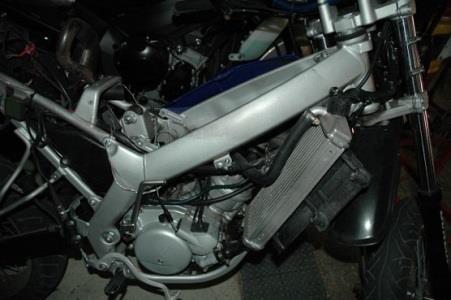
Why — Explanation
Coolant must be checked with the engine stopped and cold, which gives an accurate reading and avoids burns from hot, pressurised liquid.
Question 5
Why — Explanation
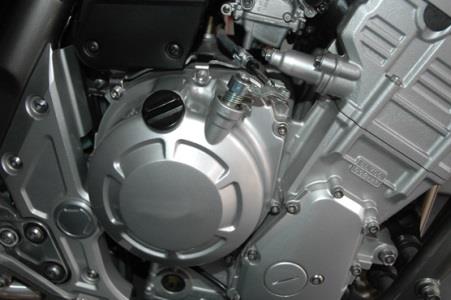
The oil level is read with the engine stopped and cold and the motorcycle held vertical, so the oil settles and the reading is correct.
Question 6
Why — Explanation
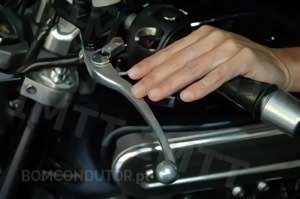
The levers have built-in reach adjusters so the rider can set them to suit hand size, without a workshop visit.
Question 7
Why — Explanation
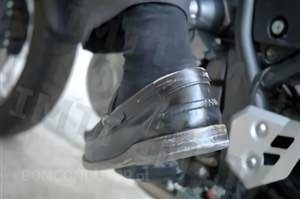
Fully disengaging the clutch before selecting a lower gear lets the engine and gearbox speeds match smoothly and protects the transmission.
Question 8
Why — Explanation
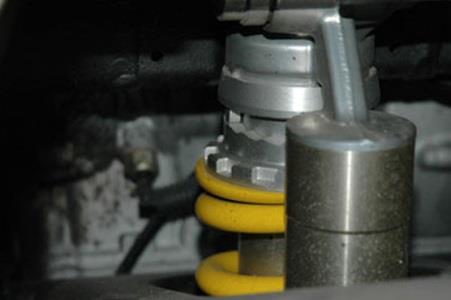
Rear monoshock units have an adjustable preload ring, so the rider can set the spring preload for load and riding conditions.
Question 9
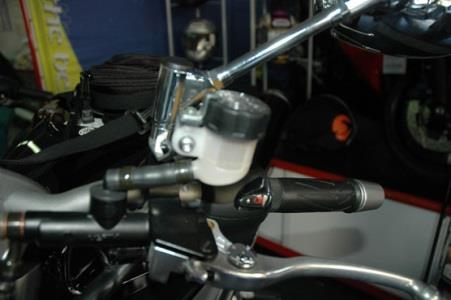
Why — Explanation
Hydraulic clutch fluid can drop over time, so the rider should check the reservoir level regularly.
Question 10
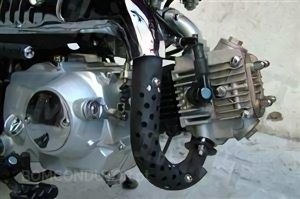
Why — Explanation
A two-stroke engine has no separate oil sump, so the petrol and oil mixture lubricates its internal parts.
Question 11
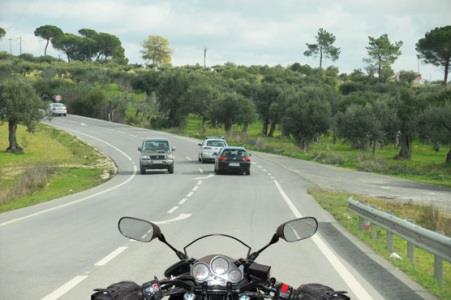
Why — Explanation
Worn or incorrectly inflated tyres reduce grip and directly lengthen the braking distance.
Question 12
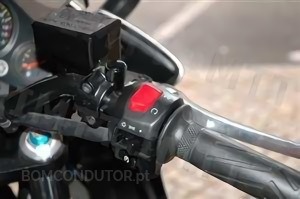
Why — Explanation
The emergency cut-off switch (interruptor de paragem de emergência) only stops the engine, so the rider can switch it off quickly in an emergency.
Question 13
Why — Explanation
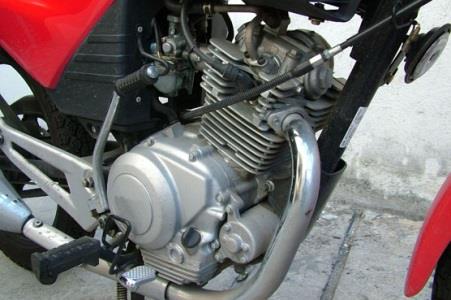
The engine in the figure has a single cylinder, so it is a single-cylinder (monocilíndrico) engine.
Question 14
Why — Explanation
The figure shows a single-cylinder engine, which has one piston (êmbolo).
Question 15
Why — Explanation
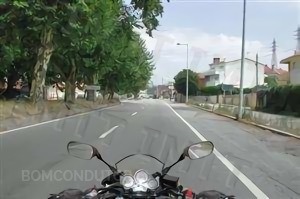
On a motorcycle the rear brake is applied with the right foot pedal, while the right hand operates the front brake lever.
Question 16
Why — Explanation
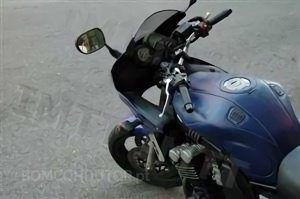
The correct free play is about 2 to 3 mm, so with 7 to 8 mm the rider should use the adjuster or numbered disc to reduce it.
Question 17
Why — Explanation
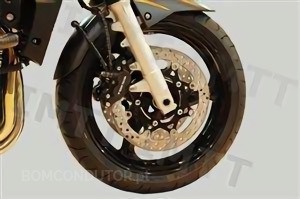
The front fork of a motorcycle normally has two suspension legs, one on each side of the wheel.
Question 18
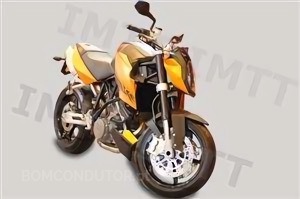
Why — Explanation
Most motorcycles use a single rear spring and damper unit (monoshock).
Question 19
Why — Explanation
Disc brakes (travões de disco) dissipate heat well and give stronger, more consistent braking than drum brakes.
Question 20
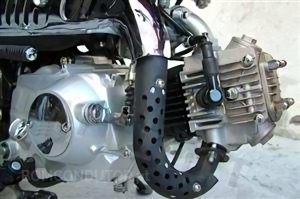
Why — Explanation
In a two-stroke engine the oil is mixed with the petrol and carried in suspension, lubricating the moving parts as the mixture passes through the engine.
1–20 / 151